Sweden
Bayrock's Lainejaur Project is a high-grade nickel–copper–cobalt sulphide project located in Västerbotten County, northern Sweden, approximately 15km northeast of the town of Malå within the highly prospective Skellefteå mineral belt.
The project consists of a single 41.2Km2 Exploration Permit that is 100% owned by Bayrock Resources through its wholly owned subsidiary Metalore Pty Ltd and benefits from excellent infrastructure access via established road networks.
Lainejaur comprises a historical underground nickel mine discovered in 1941 and brought into production during World War II, producing approximately 100,000 tonnes of ore at grades averaging around 2.2% nickel, demonstrating the presence of high-grade sulphide mineralisation within the system. The mine closed in 1945 due to low commodity prices and not due to deposit exhaustion.
A Maiden JORC (2012) Mineral Resource Estimate completed in 2018 defined an Inferred Mineral Resource of approximately 460,000 tonnes grading 2.2% Ni, 0.15% Co and 0.70% Cu, with associated platinum group and gold credits, highlighting the project’s strong grade profile relative to many global nickel sulphide deposits.
The mineralisation occurs as massive and disseminated sulphides hosted within mafic intrusive rocks and remains open along strike and at depth, providing potential for resource growth through continued exploration. Geophysical surveys and drilling programs have identified additional conductive targets interpreted to represent extensions or repetitions of the known mineralised system.
Strategically, Lainejaur is positioned within a Tier-1 mining jurisdiction and within the European Union, placing the project close to emerging European battery metal supply chains seeking secure sources of Class 1 nickel, copper and cobalt. The project represents an advanced exploration opportunity with potential to support future development of critical battery metals required for electrification and energy transition markets.
Drilling Results Summary – Lainejaur Project
Diamond drilling undertaken at the Lainejaur nickel–copper–cobalt sulphide project has successfully confirmed the presence of high-grade sulphide mineralisation consistent with the historical mine and previously defined mineral resource.
Bayrock’s 2023 drilling program targeted extensions of known mineralisation and geological continuity within the mafic intrusive host rocks. The first diamond drillhole (LAI23001) intersected zones of massive and disseminated sulphides, including visible nickel and copper mineralisation within a strongly mineralised gabbro unit. The mineralised interval formed part of a broader sulphide-bearing zone, confirming the interpreted geological model and continuity of high-grade mineralisation at depth.
Assay results reported included, 4.7 metres grading 2.0% nickel, 1.6% copper and 0.1% cobalt from approximately 283 metres downhole, within a broader mineralised interval of approximately 22 metres.
The drilling results confirmed the presence of nickel–copper–cobalt sulphide mineralisation previously identified in historical drilling and mining operations, demonstrating geological continuity and validating strong potential for further resource growth through additional exploration.
Earlier historical drilling results within the project area have returned multiple high-grade intercepts, including intervals exceeding 2% nickel over several metres, providing further confidence in the high-grade nature of the Lainejaur system.
Overall, the drilling program demonstrated that the Lainejaur deposit hosts high-grade nickel sulphide mineralisation typical of magmatic sulphide systems, with mineralisation remaining open at depth and along strike, supporting ongoing exploration and resource expansion potential.
LAINEJAUR - HISTORICAL POLYMETALLIC MINE
- A nickel dominant, massive sulphide resource with considerable upside
- Discovered in the early 1940's by electrical surveying followed by excavation under moraine
- Shallow underground mine (<150meters) operated until 1945
- production of 101kt at an average grade of 2.2% Ni, 0.1% Co and 0.9% Cu
- No modern exploration was undertaken until 2007 when Blackstone Minerals completed 42 core drill holes for 13,200m
- The Lainejaur 2018 Mineral Resource Estimate was restricted to a very small 0.40km2 tenement
- Bayrock has now secured a 41.2km2 holding which enables investigation of potential down- dip extensions as well as nearby untested Ni-Cu targets.
Lainejaur Mine, early 1940s Source: Sverige Geologiska Undersokning
LAINEJAUR MINERAL RESOURCE ESTIMATE
- JORC 2012 compliant Inferred Mineral Resource of 460,000t @ 2.2% Ni, 0.7% Cu, 0.15% Co, 0.68/t Pd, 0.2g/t Pt and 0.65g/t Au (3.4% NiEq)
- The Resource is open down dip and does not include a considerable tonnage of low-grade Ni and Cu
- Drill intersections (within the Resource) include:
- 7.65m @ 2.1% Ni, 0.10% Co and 1.01% Cu from 168m in LAI-07-010
- 5.18m @2.64% Ni, 0.10% Co and 0.06% Cu from 215.9m in LAI-07-14A
- 9.88 @ 2.28% Ni, 0.17% Co and 0.61% from 277.35m in LAI-07-15
Lainejaur is located in the established Skellefteå mining district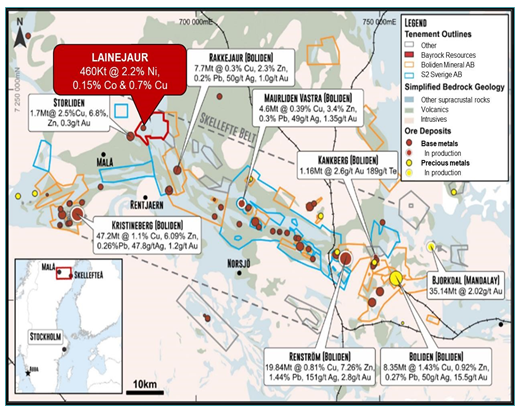
LAINEJAUR - RESOURCE EXTENSION POTENTIAL
- The deposit is open down dip and the deepest intersection was 2.85 meters of 1.63% of Ni, 0.51% Cu, 0.19% Co,2.16g/t Pd, 0.62 g/t and 0.83 g/t Au from 558.3m, including 0.7m of 2.89% Ni, 0.13% Co, 8.8g/t Pd, 2.5g/t Pt and 2.9g/t Au
- Mines in the Skelleftea Mining District operate to more than 1500 meters depth
- A considerable tonnage (~1.4Mt) of lower grade Ni-Cu halo mineralisation grading >0.5%NiEq was not included in the 2018 Mineral Resource Estimate
LAINEJAUR - WIDER PROJECT EXPLORATION POTENTIAL
- During 2017 and 2018, Berkut Minerals (now Carnaby Resources) conducted EM and geochemical surveys
- Several new EM anomalies were identified along a 6km arc from the Lainejaur deposit
- These anomalies are priority drill targets for Lainejaur ‘lookalike’ deposits
- A surface veneer of transported glacial sediment, commonly 15-25 thick, covers much of the Lainejaur surrounds and improvements in geophysical application now provide better detection of buried nickel sulphides
Lainejaur Corridor EM anomalies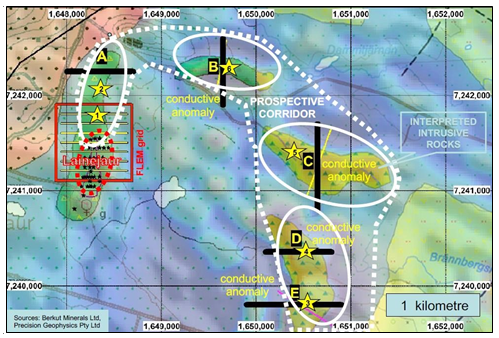
Berkut Minerals Limited (now Carnaby Resources Limited) announced the most recent Mineral Resource Estimate for the Lainejaur deposit on 12 February 2018. The information that relates to the 2018 Lainejaur Mineral Resource Estimate was based on information compiled by Mr Paul Payne, an employee of PayneGeo and a Fellow of the AusIMM. The information that relates to exploration and drill results at Lainejaur was provided by Mr Rob Watkins, a Director of Carnaby Resources Limited and a Member of the AusIMM. Both Mr Payne and Mr Watkins have sufficient experience that are relevant to the style of mineralisation and type of deposit under consideration and to the activities which they undertook to each qualify as a Competent Person as defined in the December 2012 edition of the “Australasian Code for Reporting of Exploration Results, Mineral Resources and Ore Reserves” (JORC Code).
Nickel Equivalent calculation: The NiEq % calculation for Lainejaur used throughout this website is based on prevailing metals prices as of 15 December 2021 and calculated using the formula NiEq kt = (Ni kt * Ni price + Cu kt * Cu price + Co kt * Co price + Pd oz * Pd price + Pt oz * Pt price + Au oz * Au price) / Ni price, then NiEq kt / Mineral Resource Tonnage.
Other information that relates to the projects have been provided by Dr Ian J. Pringle, Non Executive Director and former Managing Director of Bayrock Resources Limited and a Member of the AusIMM. Dr Pringle has sufficient experience that is relevant to the style of mineralisation and type of deposit under consideration and to the activities which he undertook to qualify as a Competent Person as defined in the December 2012 edition of the “Australasian Code for Reporting of Exploration Results, Mineral Resources and Ore Reserves” (JORC Code).